Why do your eyes feel dry and gritty by the end of the day

Estimated reading time 7 minutes
There is a particular kind of discomfort that builds slowly. Your eyes feel fine in the morning. By early afternoon there is a faint irritation. By evening, they feel scratchy, heavy, and tired in a way that is hard to describe but impossible to ignore. You blink more. You rub them. Nothing quite helps.
Most people assume this is just tiredness. Something to sleep off. But if it keeps happening — day after day, regardless of how much sleep you get — it is worth understanding what is actually going on.
What is dry eye?
Dry eye is not simply a lack of tears. Your eyes are coated in a thin tear film that keeps the surface of the eye moist, clear, and comfortable. That film is made up of three layers — an oily outer layer, a watery middle layer, and a mucin layer closest to the eye — and all three need to be working together for your eyes to feel normal.
When any part of that system breaks down, the surface of the eye is left exposed and unprotected. The result is dryness, irritation, and that gritty sensation that feels like something is caught in your eye even when nothing is there.
It is more common than most people realise. Dry eye affects millions of people in the UK, and many of them never connect the daily discomfort to an actual condition that can be treated.
Why does it tend to get worse as the day goes on?
This is one of the most consistent patterns with dry eye, and there are a few reasons it happens.
Blinking less than usual. During focused activity — reading, working at a screen, concentrating — people blink far less than normal. Every blink spreads the tear film across the surface of the eye and refreshes it. Fewer blinks means the film thins out and breaks down faster. This is one of the main reasons digital eye strain and dry eye so often go hand in hand.
The tear film runs out of resources. The meibomian glands along the edge of your eyelids produce the oily layer that stops the watery part of your tear film from evaporating. If those glands are not producing well — which becomes more common with age, and with extended screen time — the film becomes unstable and evaporates more quickly throughout the day.
Indoor environments. Central heating and air conditioning both reduce humidity. Sitting in a warm, dry office or home for several hours actively draws moisture away from the eye surface. By late afternoon, the cumulative effect becomes noticeable.
Contact lens wear. Lenses sit on the tear film and compete with the eye surface for moisture. After many hours, this makes dryness more likely, particularly if the lenses are not well-suited to your eyes or are being worn longer than recommended. If you are new to lenses, this is something a good contact lens fitting should cover with you from the start.
What does dry eye actually feel like?
The symptoms vary between people, but the most common ones include:
- A gritty or sandy sensation, as if something is in your eye
- Eyes that feel tired or heavy even when you are not sleepy
- Burning or stinging, particularly in the afternoon or evening
- Redness that comes and goes
- Blurring that clears when you blink but returns shortly after
- Sensitivity to light, wind, or air-conditioned environments
- Eyes that water excessively — which sounds counterintuitive, but is actually a reflex response to dryness
That last point catches people out. If your eyes water frequently, you might assume dryness is not the problem. In fact, the opposite can be true. When the eye surface dries out, it sends a signal to produce more watery tears. Those reflex tears are not the same quality as your normal tear film, and they flood the eye without solving the underlying problem. There is more on this in why your eyes water when you are tired.
Who is more likely to experience it?
Dry eye becomes more common with age, partly because tear production naturally decreases over time, and partly because the meibomian glands can become blocked or less efficient. It is particularly common after the age of 40.
Women are more likely to be affected than men, partly due to hormonal changes associated with menopause.
Extended screen use — which now describes most working adults — is one of the biggest contributing factors, and it is affecting younger people too.
Certain medications can reduce tear production, including antihistamines, antidepressants, blood pressure medications, and the contraceptive pill. If you take any of these regularly and find your eyes are frequently dry, that connection is worth noting.
Contact lens wearers, people who have had laser eye surgery, and those who spend time in dry or air-conditioned environments are also at higher risk.
What can be done about it?
Dry eye is manageable, and in many cases significant improvement is possible with the right approach. The key is identifying what type of dry eye you have, because the treatment differs depending on the cause.
Artificial tears are often the first step. These are lubricating eye drops available without a prescription. They supplement your natural tear film and provide temporary relief. Not all drops are the same — some are better for mild, occasional dryness, while others are formulated for more persistent symptoms or for use with contact lenses.
Warm compresses can help if the problem is related to the meibomian glands. Applying a warm cloth or a dedicated eye mask to closed eyelids for several minutes softens the oils in those glands and encourages them to flow more freely. Done consistently, this can make a real difference over time.
Lid hygiene — gently cleaning along the eyelid margins — is often recommended alongside warm compresses, as it helps to keep the gland openings clear.
Environmental changes can reduce the daily burden on your tear film. Taking regular breaks from screens, using a humidifier, positioning fans and vents so they do not blow directly towards your face, and increasing your water intake all help.
Omega-3 fatty acids — found in oily fish, flaxseed, and available as supplements — have good evidence behind them for supporting the oily layer of the tear film when taken consistently over time.
If these measures do not bring enough relief, or if your symptoms are more severe, there are prescription treatments available, including anti-inflammatory drops and in-practice procedures to unblock and express the meibomian glands.
When is it worth getting checked?
If dry, gritty eyes are a regular occurrence — particularly if they are affecting your concentration, your comfort at work, or how long you can tolerate contact lenses — it is worth having it assessed properly.
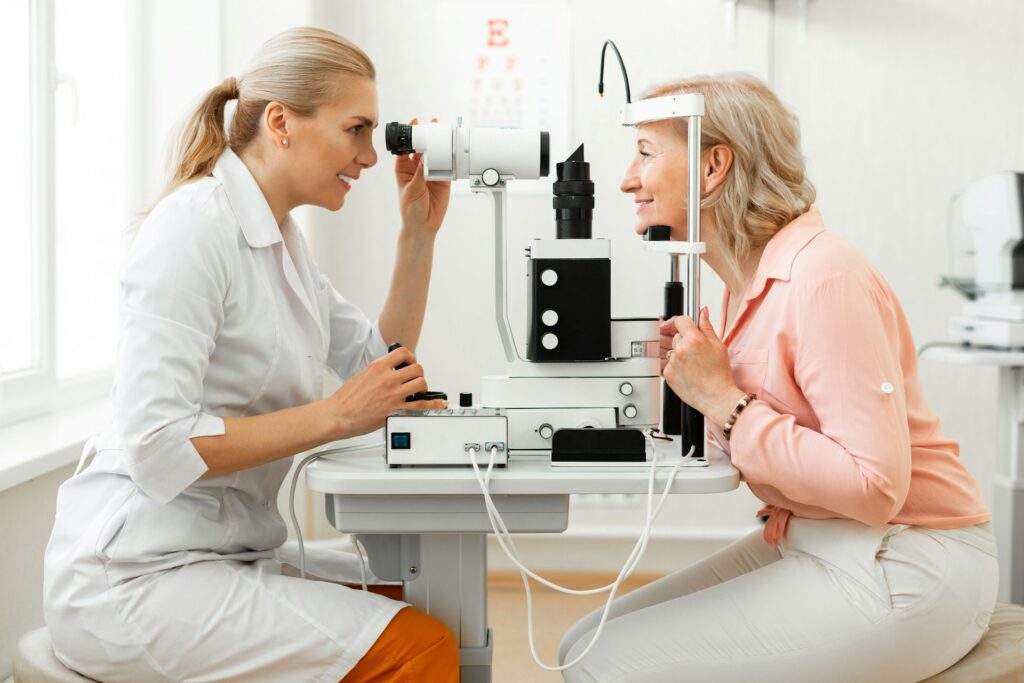
An optician can evaluate your tear film, check the condition of your meibomian glands, and help identify what is driving your symptoms. This makes treatment much more targeted than simply trying one drop after another and hoping something works. If you are not sure whether your symptoms warrant a visit, this guide on whether you need an eye test is a useful starting point.
It is also worth getting checked if you notice any of the following alongside your dry eye symptoms: persistent redness, significant light sensitivity, pain rather than just discomfort, or any change in your vision that does not clear with blinking.
At Iology in Barking, we see dry eye regularly and can talk through what you are experiencing and what is most likely to help. If your eyes are bothering you by the end of most days, that is not something you have to put up with.